The Analog Anchor in a Digital Sea
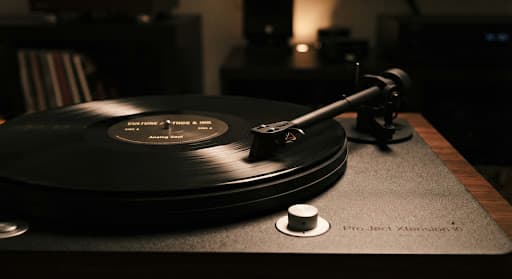
There is a particular kind of silence that precedes a record dropping onto a turntable — the hiss before the needle finds the groove, the almost imperceptible crackle that tells you something real is about to happen. No algorithm queued this up for you. No autoplay countdown ticked down in the corner of a screen. You chose this, physically, with your hands, and now you have to sit with the consequences of that choice for the next twenty-two minutes.
The Weight of the Object
Digital media promised us liberation from clutter, and it delivered. A phone can hold more music than a warehouse of vinyl, more books than a small-town library, more photographs than a family could accumulate in a century. But somewhere in that liberation, we lost something we didn't know to protect: friction. The pleasant, deliberate resistance of an object that takes up space, that has weight, that asks something of you before it gives something back.
A physical book doesn't notify you. A vinyl record doesn't autoplay the next one. A film camera doesn't let you see the shot until it's already gone, developed days or weeks later, filtered through memory rather than a screen. These aren't inconveniences we've simply tolerated out of nostalgia — they are, we're beginning to realize, the very mechanisms that made the experience mean something in the first place.
"Friction is not the opposite of pleasure. It is very often the source of it."
The Ritual of Attention
What analog media asks of us, above all, is attention — sustained, undivided, and slightly inconvenient. Dropping a needle is a small ceremony. Turning a physical page is a small commitment. Loading film is a small act of trust in a process you cannot immediately verify. Each of these rituals carves out a boundary around the experience, a beginning and an end, in a way that infinite digital feeds are specifically engineered not to.
Contrast this with the scroll — a format with no natural stopping point, designed to dissolve the edges of an experience so thoroughly that twenty minutes and two hours feel identical from the inside. The tactile object, by its nature, resists this. It has a side A and a side B. It has a last page. It runs out of film. Its limitations are not bugs; they are the shape of its meaning.
What Tactility Still Offers
- A record's imperfections — the pop of dust, the warmth of analog compression — as a reminder that the object has a history, not just a playback function
- The physical act of shelving, sorting, and returning to a book, which builds a relationship with it over years rather than a single sitting
- The deliberate pacing of film photography, where scarcity of shots forces a kind of visual discipline
- The shared, singular experience of a printed newspaper or magazine, read start to finish rather than algorithmically reordered per reader
- The simple sensory pleasure of paper weight, ink smell, and needle drop — inputs no screen has yet replicated
What We Lose in Frictionless Convenience
None of this is an argument against digital media, which has democratized access to culture in ways no previous generation could have imagined. The argument is narrower and, I think, more urgent: that a culture optimized entirely for frictionless convenience will slowly lose its capacity for the kind of attention that produces lasting meaning. Ease is not neutral. It reshapes what we value by rewarding whatever requires the least of us.
Physical media, in this light, isn't a rejection of progress — it's a counterweight. An anchor, deliberately chosen, against a current that would otherwise carry every experience toward the same frictionless, forgettable sameness.
Bringing It Back, Deliberately
This isn't a call to abandon your phone or swear off streaming. It's a suggestion to reintroduce a small amount of intentional friction back into how you engage with culture — not as performance, but as practice.
The digital sea isn't going anywhere, and it shouldn't. But every anchor needs somewhere solid to catch — some tactile, imperfect, physically present thing that reminds us attention is not the same as access, and that the best experiences are very often the ones that ask something of us first.