Silence as a Canvas: Minimalist Art Today
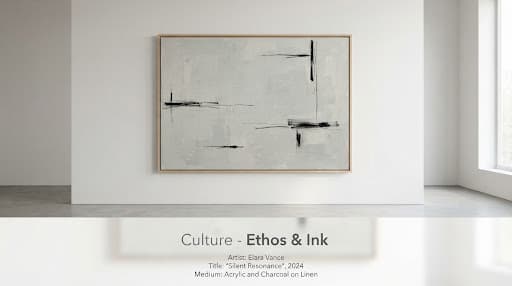
Stand in front of a canvas that is mostly empty and the first instinct, for many people, is impatience. Where is the rest of it? But wait a moment longer and the emptiness starts to behave differently — not as an absence, but as a held breath, a space actively doing something rather than a space where something is missing. This is the wager that minimalist artists have always made: that restraint is not the opposite of expression, but one of its most demanding forms.
That wager has aged unevenly. Minimalism has been celebrated as the height of sophistication and dismissed as an emperor-has-no-clothes joke in roughly equal measure over the past sixty years, and both reactions, oddly, tend to come from taking the empty canvas at face value rather than asking what the emptiness required to arrive at.
The Discipline of Less
Minimalism is frequently mistaken for simplicity, and it is almost never simple to make. Removing everything but the essential requires knowing, with total precision, what the essential actually is — a single line, a specific proportion of empty field to mark, a color chosen and then second-guessed a hundred times before it survives onto the canvas. What looks effortless is usually the result of a much longer process of subtraction than a more maximalist work would ever require.
Removing everything but the essential requires knowing exactly what the essential is.
A Brief History of Restraint
The lineage runs longer than most casual viewers assume. The concept of ma in Japanese aesthetics — the meaningful pause, the interval between things that is not empty but structural — predates Western minimalism by centuries, and shaped everything from ink painting to garden design around the idea that what is left out organizes what remains. Mid-century American painters arrived at something related from a different direction entirely: Agnes Martin's faint graphite grids, Ad Reinhardt's nearly black canvases, and Mark Rothko's soft-edged color fields were not simply reductions of a busier style, but attempts to build paintings around a single, sustained encounter rather than a sequence of details to move through.
What unites these otherwise quite different traditions is a shared bet: that a viewer given less to look at will, if the work is made carefully enough, look harder rather than look away. That bet does not always pay off, and minimalist work has always had a genuine failure mode distinct from its successes — canvases that are simply underdeveloped, mistaking absence itself for the achievement, rather than absence in service of a specific, considered effect.
What Emptiness Makes Room For
Contemporary artists working in this vein are not simply continuing a mid-century tradition; they are responding to a specific, present-day condition. Visual culture now moves fast and demands to be understood in the half-second before a thumb scrolls past it. Minimalist work refuses that transaction. It cannot be fully absorbed at a glance, and that friction is deliberate — it asks the viewer to slow down, to stay in front of the piece longer than feels efficient, and to notice what changes in their own attention as they do.
- Painters working in restrained, near-monochrome fields that reveal subtle variation only under sustained looking
- Sculptors reducing form to single, precise gestures rather than accumulations of material
- Photographers embracing negative space as the primary subject of a frame, rather than a backdrop to it
- Installation artists using near-empty rooms to make a viewer newly aware of their own presence and movement
The Market's Discomfort With Silence
There is a practical tension worth naming honestly: minimalist work is genuinely difficult to sell relative to more maximalist or immediately legible pieces, and this shapes the field in ways that rarely get discussed alongside the philosophy. A collector browsing an art fair, moving past dozens of booths in an afternoon, is more likely to stop for a piece that announces itself instantly than one that requires ten quiet minutes to start working. Galleries know this, and it creates real pressure on artists working in restraint to either compromise toward legibility or accept a smaller, more patient audience.
The artists who hold the line tend to describe this pressure as clarifying rather than discouraging. If a piece cannot survive being overlooked by someone in a hurry, the reasoning goes, it was probably not asking for the kind of attention it needed in the first place. That is a genuinely difficult position to sustain financially, which is part of why so much of the most interesting minimalist work continues to come from artists who treat commercial success as a secondary concern rather than a primary one.
Looking Without Consuming
There is a quiet argument embedded in all of this restraint: that attention, given generously and without hurry, is itself a kind of resistance to a culture optimized for speed. A minimalist canvas does not reward a glance. It rewards the decision to stay a little longer than is comfortable — and in that extra time, something that looked at first like nothing usually turns out to be quite a lot.